
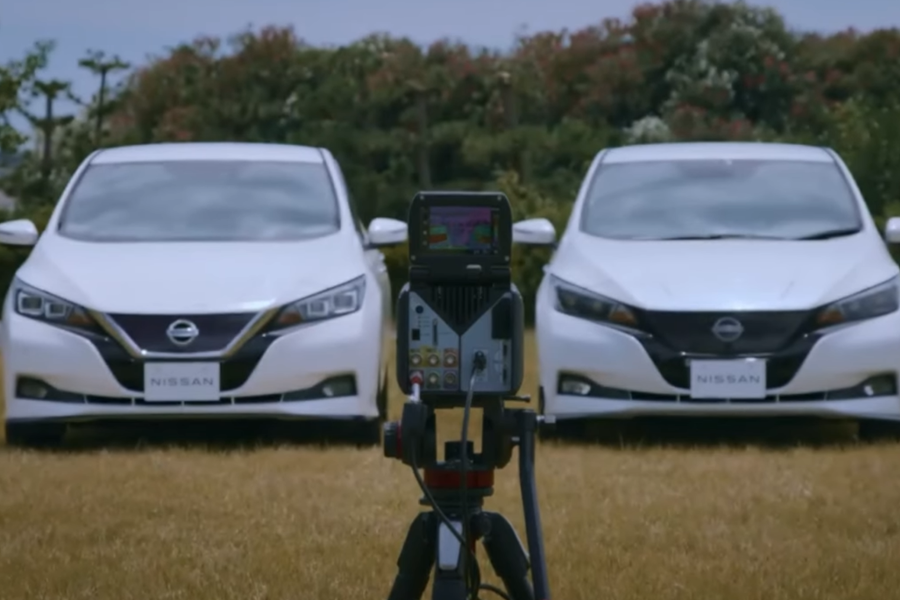
FRANKLIN, TN – Auto manufacturer Nissan has teamed up with radiative cooling product specialist Radi-Cool to develop a special type of automotive paint that, according to recent tests conducted by the two companies of its heat dissipating properties, is able to significantly improve vehicle efficiency by reducing the energy required to regulate interior temperatures.
On an especially hot day, lowering the temperature of a vehicle’s interior can take an excessive amount of time running the air conditioning, which can put an extra degree of burden on its powertrain; this is especially troublesome for electric vehicles (EVs), as the additional drain on their batteries via running the climate control system can contribute to reduced range, which is already an issue for many EV owners.
However, Nissan and Radi-Cool’s new paint technology in recent tests has been shown to be able to reduce interior vehicle temperatures by up to 9 degrees Fahrenheit and exterior surface temperatures by approximately 22 degrees Fahrenheit, thus giving the AC system a smaller hill to climb once it has been engaged.
This paint isn’t a brand-new development; Nissan has been testing it since November 2023 in Japan at Tokyo International Air Terminal at Haneda, given the fact that many of the aircraft there spend many hours each day baking under the hot sun. So far, all test vehicles have demonstrated an impressive degree of heat reduction, both in terms of their interiors and exteriors.
The paint’s ability to dissipate heat is due to metamaterials mixed into it that contain two different light-reactive microstructure particles, one reflecting the sunlight’s near-infrared rays – which produce heat – and the other redirecting the rays away from the vehicle and into the atmosphere via electromagnetic waves.
But despite the extremely positive results of their testing, Nissan notes that more work is to be done before this paint tech can be incorporated into their vehicles; currently, the paint being utilized is six times thicker than standard automotive paint, and the only current available color is white.
When these kinks are worked out, Nissan notes, the cooling paint will be made available for both commercial and passenger vehicle applications.

Christopher Boyle is an investigative journalist, videographer, reporter and writer for SEARCHEN NETWORKS® as well as other independent news and media organizations in the United States. Christopher works on a wide variety of topics and fields, has been featured in print and online in a variety of publications, from local to national, and helps keep a keen-eye on what’s happening in the automotive world for Auto Buyers Market.