
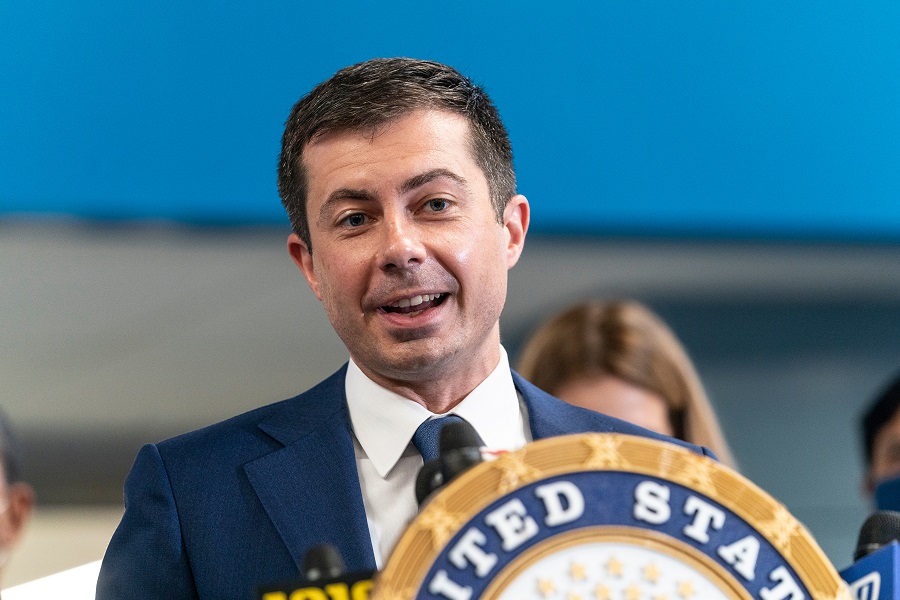
WASHINGTON, D.C. – United States Secretary of Transportation Pete Buttigieg in a recent interview spoke on the country’s gradual – but rapidly increasing – pivot towards electric vehicles (EVs) and autonomous, self-driving cars and the aspects of the technology behind them that some Americans may be having trouble coming psychologically to grips with.
More and more people are buying EVs as of late, with certain incentives put forth by the Biden Administration – including tax credits – providing a push to get more individuals to adopt these new-fangled vehicles.
But many are still remaining hesitant due to several mental hurdles over the capabilities and potential limitations of EVs and self-driving cars, with Buttigieg noting that first and foremost among these concerns being “range anxiety,” or the driver’s fear that a vehicle has insufficient energy storage needed to reach their destination.
While EV charging stations are currently not nearly as ubiquitous as gas stations are, Buttigieg noted that any electrical wall outlet in any home or office would suffice to recharge an EV in a bind; in addition, he also noted that everyday car use typically does not involve lengthily trips to out-of-town locations.
“Charging a car has more in common with charging your phone than it does with filling up your gas car, partly because for most people, you can, either at home or at work, charge your car…which is not how it works with gas stations,” he said. “We tend to buy cars for our longest trips, not our most frequent trips, such as commuting to work or running local errands around town. It will take a while for us to close the gap between the range we think we need and the range we actually need.”
He also addressed anxiety some have over self-driving cars; with the technology still being relatively new and untested in everyday use, it’s only natural to worry about autonomous vehicles posing risk. But Buttigieg was quick to point out that human drivers have proved to be far more dangerous to others than any computer-directed vehicle could hope to be so far, citing statistics showing that 2021 say 43,000 people die in car crashes, a year-over-year increase of 10.5 percent.
“Just to be very clear, human drivers aren’t just problematic. They are murderous. Forty thousand people a year die in a car crash. And we have been bathed in this level of carnage all our lives. And so we’re a bit like people who grow up in a place that’s experiencing a war, in terms of how normal we think that is,” he said. “Technology is not always the answer to everything. But frankly, it would be hard to do worse than human drivers when it comes to what we could get to theoretically with the right kind of safe autonomous driving.”

Christopher Boyle is an investigative journalist, videographer, reporter and writer for SEARCHEN NETWORKS® as well as other independent news and media organizations in the United States. Christopher works on a wide variety of topics and fields, has been featured in print and online in a variety of publications, from local to national, and helps keep a keen-eye on what’s happening in the automotive world for Auto Buyers Market.